

25 Best Stock Market Books
The Best Books For Stock Market Beginners In India
If you want to learn the stock market, investing, trading or portfolio management, a good book can give you something that short social-media posts and stock tips usually cannot: a structured way to understand how markets work.
The best stock market books cover much more than how to buy and sell shares. They explain investing principles, fundamental analysis, valuation, risk management, trading psychology, market history and investor behavior.
Selection
Looking for the best stock market books to improve your investing and trading knowledge? For beginners, choosing the right book can be confusing because there are thousands of investing and trading books available.
So, we have selected 25 of the best stock market books for beginners, investors and traders, covering different investing styles, stock analysis, trading psychology, technical analysis, index investing and levels of experience.
Important: No book can guarantee profits or teach a strategy that will always outperform the stock market. Use these books to develop your knowledge, decision-making process and understanding of risk.
Quick List: 25 Best Stock Market Books
| No. | Book | Author | Best For |
|---|---|---|---|
| 1 | The Intelligent Investor | Benjamin Graham | Value Investing |
| 2 | A Random Walk Down Wall Street | Burton G. Malkiel | Beginners |
| 3 | The Little Book of Common Sense Investing | John C. Bogle | Index Investing |
| 4 | How to Make Money in Stocks | William J. O’Neil | Growth Investing & Stock Selection |
| 5 | The Most Important Thing | Howard Marks | Risk & Investing |
| 6 | Reminiscences of a Stock Operator | Edwin Lefèvre | Trading Psychology |
| 7 | Buffett: The Making of an American Capitalist | Roger Lowenstein | Warren Buffett |
| 8 | Market Wizards | Jack D. Schwager | Trading |
| 9 | Trade Your Way to Financial Freedom | Van K. Tharp | Trading Systems & Psychology |
| 10 | One Up On Wall Street | Peter Lynch | Stock Selection |
| 11 | The Little Book That Beats the Market | Joel Greenblatt | Value Investing |
| 12 | Liar’s Poker | Michael Lewis | Wall Street |
| 13 | The Alchemy of Finance | George Soros | Market Thinking |
| 14 | Fooled by Randomness | Nassim Nicholas Taleb | Risk & Randomness |
| 15 | Japanese Candlestick Charting Techniques | Steve Nison | Technical Analysis |
| 16 | Extraordinary Popular Delusions and the Madness of Crowds | Charles Mackay | Market Bubbles & Crowd Behavior |
| 17 | Common Stocks and Uncommon Profits | Philip Fisher | Fundamental Analysis |
| 18 | Irrational Exuberance | Robert J. Shiller | Market Bubbles |
| 19 | When Genius Failed | Roger Lowenstein | Risk & Financial Crises |
| 20 | Encyclopedia of Chart Patterns | Thomas N. Bulkowski | Chart Patterns |
| 21 | The Financial Diet | Chelsea Fagan | Personal Finance |
| 22 | The Psychology of Money | Morgan Housel | Investing Psychology |
| 23 | The Little Book of Value Investing | Christopher H. Browne | Value Investing |
| 24 | Stay the Course | John C. Bogle | Long-Term / Index Investing |
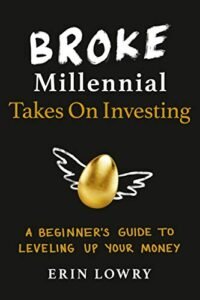
| 25 | Broke Millennial Takes on Investing | Erin Lowry | Investing Beginners |
Best Stock Market Books for Beginners
If you are completely new to investing, you don’t need to start with an advanced trading book. Start with books that explain how markets work, how investors think, how companies are valued and how risk should be managed.
Some of the best starting points include:
- The Intelligent Investor
- A Random Walk Down Wall Street
- One Up On Wall Street
- The Little Book of Common Sense Investing
- The Psychology of Money
- Broke Millennial Takes on Investing
A beginner should focus on understanding investing principles rather than trying to find a book promising quick profits.
1. The Intelligent Investor – Mr. Benjamin Graham
Best for: Value investing and understanding investment risk

The Intelligent Investor was written by Mr. Benjamin Graham, the mentor of Mr. Warren Buffett, the greatest investor of all time. For good reason, it’s known as the “Bible of the Stock Market.“
The stock market’s basics are wonderfully described. This book is divided into three sections.
First, a defensive investor’s approach to investing. Market behavior and risk management are explained by the second and third ideas.
Despite the fact that Benjamin Graham’s book “The Intelligent Investor” was initially published in 1949, much of its original advice still remains true, from the significance of value investing and loss minimization to avoiding emotional decision-making in the financial markets.
The most recent version, however, has been updated with contemporary market data as well as comments and footnotes by financial journalist Jason Zweig. It has sold over a million copies globally and has received endorsements from industry leaders and newspapers such as Barron’s.
Mr. Benjamin Graham’s famous 1934 book illustrates how even novice investors may become savvy investors by simply evaluating firms and managing their long-term risks. The book’s main focus is on long-term profits rather than short-term advantages. The book is particularly useful for investors who want to develop a long-term approach to stock market investing.
What You Can Learn
- Value investing
- Margin of safety
- Market fluctuations
- Risk management
- Defensive investing
- Investor psychology
- Long-term thinking
2. A Random Walk Down Wall Street – Burton G. Malkiel
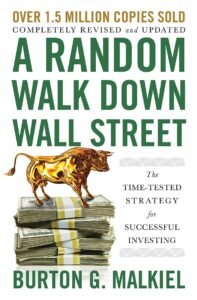
Best for: Beginners and long-term investors
The book discusses diversification, asset allocation, market behavior, bubbles and different approaches to investing. Now in its eleventh edition, is an excellent introductory read for anybody beginning a portfolio. Indexing, diversification, trends, bubbles, the significance of patience and time, and a slew of other key ideas are all prominent therein.
Burton G. Malkiel’s A Random Walk Down Wall Street, which has sold a million copies, remains near the top of investor reading lists for good reason.
This book, now in its 12th edition, offers a straightforward approach to investing, covering topics such as stocks and bonds, behavioral finance, and even physical assets like gold and coins. From Wall Street to the Great Wall and The Random Walk Guide to Investing was also written by Malkiel, the Chemical Bank Chairman’s Professor of Economics Emeritus at Princeton University.
What You Can Learn
- Stock market basics
- Diversification
- Asset allocation
- Market efficiency
- Investing psychology
- Long-term investing
3. The Little Book of Common Sense Investing- John C. Bogle
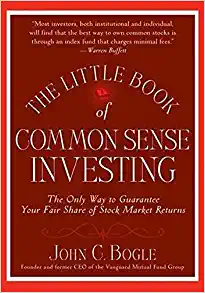
Best for: Index investing
The Vanguard Group, founded by Jack Bogle, is recognized for offering the lowest-cost mutual funds in the market. Jack’s message is straightforward: keep costs low and invest for the long term in market indices. Common Sense on Mutual Funds, Jack’s second best-selling book, delves further into mutual fund investment. Jeremy Siegel’s Stocks for the Long Run is another excellent book with a similar premise.
If you don’t understand index funds, you don’t understand investing. John C. Bogle, the creator of the Vanguard Group, emphasizes this in his book “The Little Book of Common Sense Investing.” It delves into Bogle’s low-cost index fund investment technique, covering how to make index fund investing work for you and your portfolio.
This 10th-anniversary version has been revised to provide fresh material relevant to today’s market. Nonetheless, it remains a must-read for all investors. Bogle’s other books include “Common Sense on Mutual Funds” and “Enough.”
What You Can Learn
- Index investing
- Mutual funds
- Investment costs
- Diversification
- Long-term investing
- Passive investing
4. How To Make Money In Stocks- William O’Neil

Best for: Growth investing and stock selection
This is a classic by William O’Neil that explains the ins and outs of his CANSLIM technique for discovering potential large winners in the stock market as well as how to time entry and exits. It is a fantastic guide for beginning investors since it mixes fundamental and technical research.
“How to Make Money in Stocks:
A Winning System in Good and Bad Times” is authored by William O’Neil, a well-known entrepreneur and the founder of William O’Neil & Co. Inc., a stock brokerage firm.
The book is an excellent addition to any investor’s library because it contains a wealth of information about stock market trading.
The author illustrates the finest methods and approaches by using examples from his personal trading experience.The “CANSLIM” approach, developed by the author himself, will be explained to readers.
The approach combines technical and fundamental research to assist an investor to learn how to limit losses on assets and when to do so. Aside from that, if you ever consider swing trading, you should keep track of certain swing trading books that will help you through the process.
What You Can Learn
- Stock selection
- Growth investing
- Fundamental analysis
- Technical analysis
- Market timing
- Risk management
5. The Most Important Thing Illuminated- Howard Marks

Best for: Risk management and investment thinking
Rather than presenting a simple formula for choosing stocks, Marks discusses concepts such as risk, cycles, second-level thinking, price versus value and patience.
This makes it particularly useful once you understand the basic concepts of investing.
Howard put together a list of the 21 most important things to know about investing based on his Oaktree Capital client notes. The book covers “second-level thinking,” the price/value connection, patient opportunism, and defensive investment as well as other strategies for long-term success.
What You Can Learn
- Investment risk
- Market cycles
- Second-level thinking
- Price versus value
- Contrarian thinking
- Investment discipline
6. Reminiscences Of A Stock Operator- Edwin Lefèvre
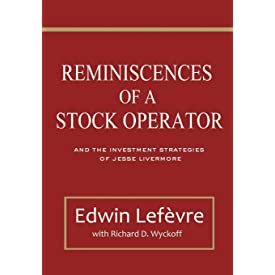
Best for: Trading psychology
Reminiscences of a Stock Operator is a classic work based on the experiences of a fictionalized stock trader. This is a page-turner of a novel. It’s a gripping account of how a young lad, despite falling penniless several times during his career, managed to accumulate one of the world’s greatest fortunes by speculating. He offers timeless investment advice (“I’ve always earned my money by sitting, not thinking”) that will benefit your trade for years to come.
Rather than being a traditional investing textbook, it explores the behavior, mistakes and emotional challenges involved in speculation and trading.
It is particularly valuable for understanding why discipline and psychology matter in trading.
What You Can Learn
- Trading psychology
- Speculation
- Risk
- Market behavior
- Trader discipline
- Emotional decision-making
7. Buffett: The Making Of An American Capitalist- Roger Lowenstein

Best for: Understanding Warren Buffett’s investing philosophy
This book provides insight into the Oracle of Omaha’s methods. Warren Buffett’s ideas are smart, and his strategies may pay off for those who have the patience to learn, understand, and implement them effectively.
Roger Lowenstein’s biography examines Warren Buffett’s life and the development of his investment philosophy.
For readers interested in Warren Buffett, the book provides historical context around how Buffett developed his approach to businesses, valuation and long-term investing.
What You Can Learn
- Warren Buffett’s investing philosophy
- Value investing
- Business analysis
- Long-term thinking
- Investment discipline
8. Market Wizards – Jack Schwager
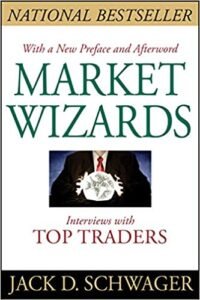
Best for: Trading and trader psychology
This book contains interviews with successful traders from the 1970s and 1980s. Their tales are intriguing and motivating, and traders may learn a great deal from them. Jack Schwager’s original interviews became so well-known that he went on to write four more books: The New Market Wizards (1994), Stock Market Wizards (2003), Hedge Fund Market Wizards (2012), and The Little Book of Market Wizards, which summarised the most important lessons from nearly 50 interviews (2014)
Market Wizards brings together interviews with successful traders and explores how different traders approach markets.
One of the interesting lessons from the book is that successful traders can use very different strategies while still sharing common principles such as risk management, discipline and controlling losses.
What You Can Learn
- Trading strategies
- Risk management
- Trading psychology
- Position sizing
- Trader discipline
- Market experience
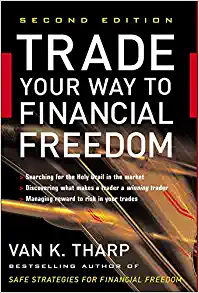
9. Trade Your Way To Financial Freedom- Van Tharp
Best for: Trading systems and psychology
Van K. Tharp’s book focuses on developing a systematic approach to trading.
It discusses areas such as position sizing, risk management, trading psychology and the importance of having a defined trading plan.
This is more appropriate for readers who already understand basic market terminology.
This is a rare find that covers both investor psychology and system design. While it may not provide you with the “Holy Grail” (an unbeatable strategy for trading the markets), it will provide you with the fundamentals you need to build a winning system. This book contains something for everyone.
Van Tharp, the author, is a well-known expert in the subject of trader psychology, having worked in the field since 1982. “Trade Your Way to Financial Freedom,” which was released in 2006, was a tremendous hit at the time and is still revered by investors. The book includes interviews with the author and some of his clients who he assisted in achieving better investing success.
The book includes chapters on investor psychology, fundamental analysis, technical analysis, and a systematic approach, among other advanced subjects. A beginner will learn some of the most important aspects of trading, such as money management and the risk-to-reward ratio, which may help investors avoid losses.
What You Can Learn
- Trading systems
- Position sizing
- Risk management
- Trading psychology
- Risk-to-reward concepts
- Trading plans
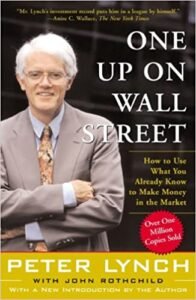
10. One Up On Wall Street- Peter Lynch
Best for: Individual investors
This is a timeless investment that will inspire individual investors. Peter Lynch explains why Wall Street may not be able to identify the finest investment possibilities right away and demonstrates how an individual investor may find the next big winner step by step.
Peter Lynch, the book’s author, is one of the most successful fund managers, with an average yearly return of 30% during a 13-year period. The book clearly covers the fundamentals and is a must-read for all beginners before embarking on their investing travels.
This book covers everything from planning to invest, how to invest when to invest, and why to a long-term investing strategy. Details on the various equities on the market, as well as how to acquire them, are also provided.
Do you want to be a step ahead of the competition?
So who better to learn from than one of history’s most illustrious investors? “One Up On Wall Street,” by Peter Lynch, focuses on how regular investors may beat professionals simply by seeing daily investing possibilities before they do.
Finding a “ten-bagger,” or a stock that increases tenfold after you acquire it is what this is termed. Lynch is the co-author of the blockbuster books “Beating the Street” and “Learn to Earn,” as well as vice-chairman of Fidelity Management & Research Company and former portfolio manager of Fidelity Magellan Fund.
The author of “One Up on Wall Street” is an excellent fund manager from the United States. The basics of the stock market, as well as techniques for profiting from it, are covered in this book. As a consequence, it is ideal for first-time investors.
If you want to make a long-term investment in the stock market, you must select the finest stock for you. Peter Lynch outlines the process for selecting the best stocks in his best-selling investing book. As a consequence, you’ll be able to obtain better returns on your investment items.
The investing book also includes six distinct types of companies, each of which necessitates a particular technique from those interested, as Peter describes below. Stock forms include slow growth/sluggards, stalwarts, fast growers, cyclicals, turnarounds, and asset plays.
What You Can Learn
- Stock selection
- Fundamental analysis
- Long-term investing
- Business analysis
- Growth investing
If you’re looking for a stock market book for beginners, this is one of the more accessible choices on this list.
11. The Little Book That Beats The Market- Joel Greenblatt
Best for: Value investing
This book delves into the fundamentals of stock market investment. The author’s proven “magic formula investing” approach of beating the market by investing in high-quality firms at low costs is deconstructed in this book.
The revised version of Joel Greenblatt’s “The Little Book That Beats the Market,” which was initially released in 2005 and sold more than 300,000 copies, is fittingly titled “The Little Book That Still Beats the Market”.
It teaches prospective investors how to regularly outperform the market by following the author’s straightforward technique for buying stocks at rock-bottom prices. But don’t worry: Greenblatt explains everything in clear English and without jargon. This version includes information about the financial crisis, as well as how the formula fared throughout that period.
This book contains a lot of magical tips for outperforming the stock market and maximising profits. Earning Yield and Return on Capital are two of the most significant formulae given by the author. By selling equities at discounted prices, they earn the greatest money for investors. You will certainly obtain amazing outcomes if you use these strategies. As the title indicates, it is a collection of material crammed into a tiny number of pages (only 176 pages).
What You Can Learn
- Value investing
- Stock valuation
- Return on capital
- Earnings yield
- Systematic investing
- Market performance
This book is particularly relevant to readers searching for books about outperforming the stock market.
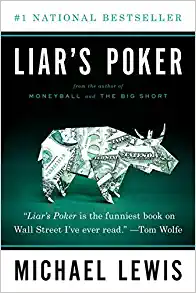
12. Liar’s Poker – Michael Lewis
Best for: Understanding Wall Street culture
Liar’s Poker provides an insider-style account of Wall Street and the author’s experiences at Salomon Brothers.
It isn’t a step-by-step guide to buying stocks, but it can help readers understand the culture, incentives and behavior surrounding financial markets.
An insider’s perspective of Salomon Brothers in the late 1980s. A fascinating, if maybe unprofitable, account of how Wall Street operates. The Big Short: Inside the Doomsday Machine and Flash Boys are two more outstanding Michael Lewis books.
What You Can Learn
- Wall Street
- Financial markets
- Trading culture
- Risk
- Financial institutions
13. Alchemy Of Finance – George Soros
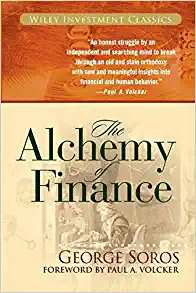
Best for: Advanced market thinking
George Soros’ The Alchemy of Finance explores his ideas about market behavior and his theory of reflexivity.
This is a considerably more advanced book than many of the beginner-friendly books on this list.
Readers who already understand investing and market concepts may find it more useful than someone completely new to the stock market.
This book, as well as Soros’s more recent work The New Financial Paradigm, discusses the author’s reflexivity thesis and how it applies to the market. It is highly insightful and enhances one’s understanding of how the financial markets function, even if it does not give a direct trading mechanism. The book is thick, but those who are willing to finish it will be rewarded.
What You Can Learn
- Market behavior
- Reflexivity
- Investment philosophy
- Market expectations
- Economic thinking
14. Fooled By Randomness – Nassim Taleb
Best for: Understanding randomness and risk
This book, which complements “The Black Swan,” explores the author’s ideas on how randomness plays a greater influence in our lives than we realize. For traders, this means that risks are generally higher than we anticipate. It would also imply that not everything in the financial world is as it seems.
Nassim Nicholas Taleb’s Fooled by Randomness explores how people often mistake random outcomes for skill or predictable patterns.
This is an important concept for investors because a successful trade or investment does not necessarily prove that the underlying decision-making process was good.
What You Can Learn
-
- Randomness
- Risk
- Probability
- Investor psychology
- Decision-making
- Market uncertainty
15. Japanese Candlestick Charting Techniques – Steven Nison
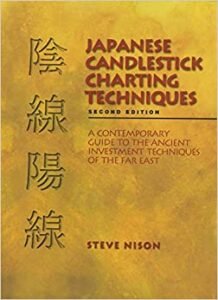
Best for: Technical analysis
Steve Nison’s Japanese Candlestick Charting Techniques is a well-known introduction to candlestick charting.
Candlestick charts are widely used by traders to visualize price movements and identify potential patterns.
However, chart patterns should not be treated as guaranteed predictions of future prices.
Candlestick charting is introduced in this book, which some investors may find beneficial in their trading. It certainly aids in making charts more visible!
-
-
- Candlestick charts
- Technical analysis
- Price patterns
- Market psychology
- Chart interpretation
-
16. Extraordinary Popular Delusions And The Madness Of Crowds – Charles Mackay

Best for: Understanding bubbles and crowd behavior
This book examines tulipmania, the South Sea bubble, and the Mississipi Land plan, demonstrating how herd mentality was used to generate bubbles in the past. It may be both an entertaining read and a useful guide for coping with future bubbles.
Charles Mackay’s classic work examines historical episodes of speculation and crowd behavior.
For stock market investors, its biggest lesson is that large groups of people can become caught up in enthusiasm, fear and speculation.
This makes the book useful for understanding market bubbles and investor psychology.
What You Can Learn
- Market bubbles
- Herd behavior
- Speculation
- Crowd psychology
- Financial history
17. Common Stocks And Uncommon Profits- Philip Fisher

Best for: Fundamental analysis
Philip Fisher’s Common Stocks and Uncommon Profits focuses on evaluating companies based on qualitative factors and their potential for long-term growth.
Fisher’s approach encourages investors to look beyond simple financial numbers and understand the quality and prospects of a business.
Buffett owes most of his success to Philip Fisher, who wrote this unappealing book. This book is a must-read for anyone who wishes to learn how to evaluate a firm qualitatively in the age of quantitative finance.
Common Stocks and Uncommon Profits is an in-depth look at financial ideas with enduring strength, updated from Philip A. Fisher’s classic tome on investing.
These topics vary from how to find growing firms to how to use the scuttlebutt approach, which entails obtaining information about a company from a variety of sources (ideally before you invest in the said company). The book’s second version, which contains advice from the author’s son Ken Fisher, a noted financial specialist, was first released in 1958 and was supported by Warren Buffett.
It’s a must-read for any investor since it sets out numerous fundamental concepts, such as keeping emotions out of the investment process.
What You Can Learn
- Fundamental analysis
- Company research
- Growth investing
- Business quality
- Long-term investing
18. Irrational Exuberance – Robert Shiller
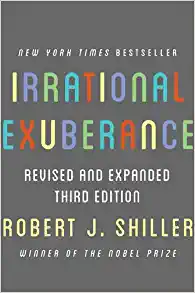
Best for: Market bubbles and valuation
Nobel Prize-winning economist Robert J. Shiller’s Irrational Exuberance examines why asset prices can become detached from fundamentals and how investor enthusiasm can contribute to market bubbles.
It is particularly useful for understanding the relationship between investor psychology, valuation and market cycles.
Robert Shiller, the 2013 Nobel Laureate in Economics, is a market expert who has devoted his career analysing market fluctuations. Irrational Exuberance, a multi-book author, looks at how trends evolve into booms and eventually burst bubbles.
What You Can Learn
- Market bubbles
- Investor psychology
- Valuation
- Market cycles
- Behavioral finance
19. When Genius Failed: The Rise And Fall Of Long-Term Capital Management – Roger Lowenstein
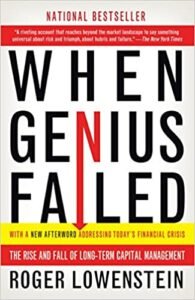
Best for: Understanding risk and financial crises
When Genius Failed tells the story of Long-Term Capital Management and its dramatic collapse.
The book demonstrates why sophisticated models, highly skilled professionals and large amounts of capital cannot eliminate investment risk.
A fascinating account of how one of the hedge fund industry’s darlings grew to prominence and then plummeted. A reminder to traders to maintain risk and their circle of competence at the forefront of their minds.
What You Can Learn
- Risk management
- Leverage
- Financial crises
- Investment models
- Market behavior
20. Encyclopedia Of Chart Patterns – Thomas Bulkowski
Best for: Technical analysis and chart patterns
Thomas N. Bulkowski’s Encyclopedia of Chart Patterns is aimed at readers who want to study chart patterns in greater depth.
It provides a more detailed reference-style approach than a beginner’s introduction to technical analysis.
Bulkowski tells you how to trade the significant events — such as quarterly earnings announcements, retail sales, stock upgrades and downgrades — that shape today’s trading and uses statistics to back up his approach. A reminder to traders to maintain risk and their circle of competence at the forefront of their minds.
What You Can Learn
- Chart patterns
- Technical analysis
- Breakouts
- Pattern analysis
- Historical market behavior
If you’re specifically looking for books to learn stock chart analysis, this is one of the more specialized choices on the list.
21. Best For Millennials: The Financial Diet- Chelsea Fagan
Best for: Personal finance beginners
The Financial Diet focuses primarily on personal finance rather than stock picking.
It covers topics such as budgeting, saving, financial habits and getting started with investing.
For someone who needs to build a strong financial foundation before investing, this can be a useful starting point.
The Financial Diet, an Indie Personal Finance Bestseller, is a terrific place to start for millennials who need a crash lesson in money management. It covers topics such as how to make and stick to a budget, how to have difficult money talks with friends, and even what items to keep on hand in the kitchen (because eating out is a major budget killer). It also covers more complex financial subjects like how to care for your home and how to get started investing. The Financial Diet is a famous website and YouTube channel created by author Chelsea Fagan.
What You Can Learn
- Personal finance
- Budgeting
- Saving
- Financial habits
- Investing basics
22. Best On The Psychology Of Investing: The Psychology Of Money – Morgan Housel
Best for: Psychology of investing and money decisions
The Psychology of Money by Morgan Housel is one of the most useful books for understanding the behavioral side of investing.
Rather than focusing mainly on stock-picking formulas, the book explores how emotions, personal experiences, biases, expectations and behavior influence financial decisions.
This is particularly important because investment results are not determined solely by financial knowledge.
An investor can understand valuation and still make poor decisions because of fear, greed, overconfidence or impatience.
This collection of 19 short tales looks at how individuals think about money as well as the mathematics that go into financial plans and investments. This book’s message—emotions matter when it comes to money—rings true for everyone who has ever made an emotional decision about their budget or investment portfolio. Morgan Housel’s The Psychology of Money not only explains how our personal emotions, biases, and ego influence our financial decisions, but also provides readers with common sense tools to help them make those judgments. Housel, a former columnist for The Wall Street Journal and The Motley Fool, is a partner at the Collaborative Fund and an award-winning financial journalist.
What You Can Learn
- Psychology of investing
- Investor behavior
- Risk perception
- Financial decision-making
- Emotional investing
- Long-term wealth building
- Behavioral biases
Is The Psychology of Money Good for Beginners?
Yes. It is particularly accessible to readers who are new to investing and want to understand how people think about money and investment decisions before moving into more technical books.
If you’re searching for the best investing psychology books, this is one of the first books to consider.
23. The Little Book of Value Investing- Christopher H. Browne

Best for: Learning value investing
Christopher H. Browne’s The Little Book of Value Investing provides an introduction to the principles of finding stocks that appear undervalued relative to their underlying businesses.
The book focuses on patience, valuation and the discipline required to follow a value-oriented investment approach.
Value investing is the strategy of buying cheap stocks and keeping them for extended periods of time in the hopes of generating higher returns when the equities recover. Despite the fact that it is not a new concept, many investors believe it is undervalued (pun intended). The Little Book of Value Investing by Christopher Browne explains how to use this technique to buy cheap stocks and increase your portfolio. The Independent, Financial Times (UK), Bloomberg, and The Wall Street Journal have all given this book high marks.
What You Can Learn
- Value investing
- Stock valuation
- Margin of safety
- Long-term investing
- Company analysis
24. Best for Index Funds: Stay the Course- John C. Bogle
Best for: Index investing and long-term investors
Stay the Course presents John C. Bogle’s philosophy around long-term investing and index funds.
The book emphasizes simplicity, diversification, keeping costs under control and avoiding unnecessary attempts to predict short-term market movements.
Index funds are critical in a passive investing approach, as every savvy investor knows. Stay the Course, by Vanguard founder John C. Bogle, is an interesting insight at investing vehicles, as he tells the storey of expanding his business from $1.4 billion to $5 trillion in assets, making it the world’s largest mutual fund firm. This book, which is part history and half index fund tutorial, is essential reading for every investor, expert or amateur.
What You Can Learn
- Index funds
- Passive investing
- Long-term investing
- Diversification
- Investment costs
- Market discipline
25. Broke Millennial Takes on Investing- Erin Lowry
Best for: Young and first-time investors
Erin Lowry’s Broke Millennial Takes on Investing is written in an approachable style for people who are beginning to navigate investing and personal finance.
It addresses practical questions that beginners commonly have when starting their investment journey.“Broke Millennial Takes On Investing,” by Erin Lowry, is one of the finest investing books for beginners because of its response to numerous topics aimed at millennial investors, such as “Should I invest while paying down student loans?” or “Should I use a robo-advisor or an investing app?” Lowry’s “Broke Millennial” series continues with the second part. Lowry has also been featured in USA Today, Cosmopolitan, and Refinery29, as well as in The New York Times, Wall Street Journal, and CBS Sunday Morning.
What You Can Learn
- Investing basics
- Getting started with investing
- Investment accounts
- Financial planning
- Beginner investing concepts
Click For More Updates: How to Open a Demat Account for Share Trading (2026)
Share Market A to Z: Complete Glossary + Free PDF (2026)
Best Stock Market Books by Category
Not everyone should read the same book. Your best choice depends on what you want to learn.
Best Books for Stock Market Beginners
Start with:
- The Little Book of Common Sense Investing
- One Up On Wall Street
- The Psychology of Money
- A Random Walk Down Wall Street
- The Intelligent Investor
Best Books on the Psychology of Investing
If your goal is to understand investor psychology and emotional decision-making, consider:
- The Psychology of Money — Morgan Housel
- Fooled by Randomness — Nassim Nicholas Taleb
- The Most Important Thing — Howard Marks
- Reminiscences of a Stock Operator — Edwin Lefèvre
- Irrational Exuberance — Robert J. Shiller
Best Books for Fundamental Analysis
For investors who want to learn how to analyze companies:
- The Intelligent Investor
- One Up On Wall Street
- Common Stocks and Uncommon Profits
- The Little Book of Value Investing
- How to Make Money in Stocks
Best Books for Technical Analysis
For readers interested in charts and technical analysis:
- Japanese Candlestick Charting Techniques
- Encyclopedia of Chart Patterns
- How to Make Money in Stocks
- Market Wizards
Remember that technical analysis is a tool for analyzing market behavior; no chart pattern can guarantee what a stock will do next.
Best Books for Traders
For trading psychology and trading systems:
- Market Wizards
- Reminiscences of a Stock Operator
- Trade Your Way to Financial Freedom
- Japanese Candlestick Charting Techniques
- How to Make Money in Stocks
Which Stock Market Book Should a Beginner Read First?
If you have never invested in the stock market before, don’t start with the most complicated book.
A simple reading order could be:
Step 1 — Understand Investing Behavior
The Psychology of Money
Learn how emotions and behavior affect financial decisions.
Step 2 — Learn the Basics
A Random Walk Down Wall Street
Understand diversification, markets and long-term investing.
Step 3 — Learn Company Selection
One Up On Wall Street
Understand how individual investors can research companies.
Step 4 — Learn Value Investing
The Intelligent Investor
Study valuation, risk and margin of safety.
Step 5 — Go Deeper
Move into books about fundamental analysis, technical analysis, trading or portfolio construction depending on your goals.
Which Book Is Best for Learning Stock Market Investing?
There isn’t one universally best stock market book.
Different books solve different problems.
If you are a complete beginner, start with The Psychology of Money or A Random Walk Down Wall Street.
If you want to learn value investing, start with The Intelligent Investor.
If you want to learn stock selection, consider One Up On Wall Street.
If you’re interested in technical analysis, start with Japanese Candlestick Charting Techniques.
If you’re interested in trading psychology, Market Wizards and Reminiscences of a Stock Operator are useful choices.
Can Books Teach You How to Outperform the Stock Market?
Some investing books present strategies designed to help investors outperform the market, but there is an important distinction between learning a strategy and consistently achieving above-market returns.
For example, Joel Greenblatt’s The Little Book That Beats the Market presents a systematic value-oriented approach, while Peter Lynch’s One Up On Wall Street focuses on identifying attractive companies through research and observation.
These books can teach you how different investors approach the market, but past performance or a historical strategy does not guarantee future returns.
The more important lesson is to understand the underlying reasoning, risk and limitations of any strategy before using it.
What Should You Look for in a Stock Market Book?
Before buying an investing book, consider what you actually want to learn.
For Beginners
Look for books that explain:
- Stock market basics
- Investing terminology
- Risk
- Diversification
- Long-term investing
For Investors
Look for:
- Fundamental analysis
- Valuation
- Company research
- Portfolio construction
- Risk management
For Traders
Look for:
- Trading psychology
- Technical analysis
- Position sizing
- Risk management
- Trading systems
For Everyone
A good investing book should encourage critical thinking rather than blind following of stock tips.
Final Thoughts
The best stock market book depends on your experience and investment goals.
You don’t need to read all 25 books.
If you’re a beginner, start with one accessible book and gradually move into more specialized subjects such as fundamental analysis, value investing, technical analysis and trading psychology.
Most importantly, don’t expect a book to provide a guaranteed formula for making money in the stock market. The real benefit of reading is developing a better understanding of risk, businesses, markets, valuation and your own behavior as an investor.
If you’re building your knowledge from scratch, a sensible starting combination is:
The Psychology of Money → A Random Walk Down Wall Street → One Up On Wall Street → The Intelligent Investor
From there, you can choose books based on whether you want to focus on investing, trading, fundamental analysis, technical analysis or portfolio management.
Frequently Asked Questions
Which is the best stock market book for beginners?
There is no single best book for everyone. The Psychology of Money, A Random Walk Down Wall Street and One Up On Wall Street are accessible starting points for beginners.
Which book is best for learning stock market investing?
A Random Walk Down Wall Street, One Up On Wall Street and The Intelligent Investor are useful for developing a foundation in investing.
What is the best book on the psychology of investing?
The Psychology of Money by Morgan Housel is a strong starting point for understanding how behavior, emotions and personal experiences influence financial decisions.
Which book is best for value investing?
The Intelligent Investor by Benjamin Graham is a classic introduction to value-investing principles. The Little Book of Value Investing is another accessible option.
Which book is best for technical analysis?
Japanese Candlestick Charting Techniques by Steve Nison and Encyclopedia of Chart Patterns by Thomas N. Bulkowski are more focused on chart-based analysis.
Which book is best for trading psychology?
Market Wizards, Reminiscences of a Stock Operator and Trade Your Way to Financial Freedom all provide useful perspectives on trading psychology and discipline.
Can I learn the stock market from books?
Yes. Books can provide a structured foundation in investing, market behavior, analysis and risk management. However, reading alone does not guarantee investment success.
Can a book teach me how to outperform the stock market?
Books can explain strategies that have historically been used to seek above-market returns, but no book or strategy can guarantee future outperformance.
I hope you enjoyed and learned a lot from this essay. Thank you very lot for your help. If you have any questions about this post, please leave a comment. We of ShareMarketBazar.com, would want to express my sincere gratitude for taking the time to read this essay. I hope you learned a lot from this.
Which book is a written by Warren Buffett’s Mentor?
Benjamin Graham, Warren Buffett’s mentor, wrote the book The Intelligent Investor.
What is the name of the author of One Up on Wall Street?
Peter Lynch, an American writer, is the author of One Up on Wall Street.
Which book is authored by John C. Bogle?
The Little Book of Common Sense Investing is authored by John C. Bogle.
Tell us about Broke Millennial Takes on Investing?
“Broke Millennial Takes On Investing,” by Erin Lowry, is one of the finest investing books for beginners because of its response to numerous topics aimed at millennial investors, such as “Should I invest while paying down student loans?” or “Should I use a Robo-advisor or an investing app?” Lowry’s “Broke Millennial” series continues with the second part.
About This Article
Last updated: August 2026
Financial Disclaimer: The information provided in this article is for educational and informational purposes only and does not constitute financial advice. SME investments carry high structural and liquidity risks. Always consult with a SEBI-registered investment advisor before deploying capital into the markets.