

Navigating the Indian stock market requires more than just picking winning stocks or timing entry and exit points. To keep what you earn, you must thoroughly understand taxation. Whether you invest in direct equity, SIPs in mutual funds, or trade actively, every rupee you earn in profits is subject to Capital Gains Tax Stocks India 2026 established by the Income Tax Department of India.
Following recent budget revisions and updated tax brackets for 2026, many retail investors are left confused about how their short-term and long-term gains are taxed. Are mutual fund returns taxed differently from direct equity? How much dividend income is tax-free? And how can you legally reduce your tax burden using tax-loss harvesting?
This comprehensive guide breaks down the complete taxation framework for stocks, equity mutual funds, debt funds, and dividend income for 2026 in plain, easy-to-understand language.
1. Understanding Capital Gains: Equity vs Non-Equity Assets
Before calculating your taxes, you need to understand how the tax department categorizes your investments based on holding period:
- Equity Investments (Listed Stocks & Equity Mutual Funds): If you hold an asset for more than 12 months, it is classified as a Long-Term Capital Asset. If held for 12 months or less, it is considered a Short-Term Capital Asset.
- Debt Mutual Funds & Unlisted Shares: The holding period threshold for long-term status differs. For debt funds and unlisted securities, holding periods and tax benefits (such as indexation) follow revised income tax slab guidelines.
2. Short-Term Capital Gains Tax (STCG) on Stocks & Equity Funds
If you sell your stocks or equity-oriented mutual fund units within one year (365 days or less) of purchase and make a profit, those profits are categorized as Short-Term Capital Gains (STCG).
Current STCG Tax Rate
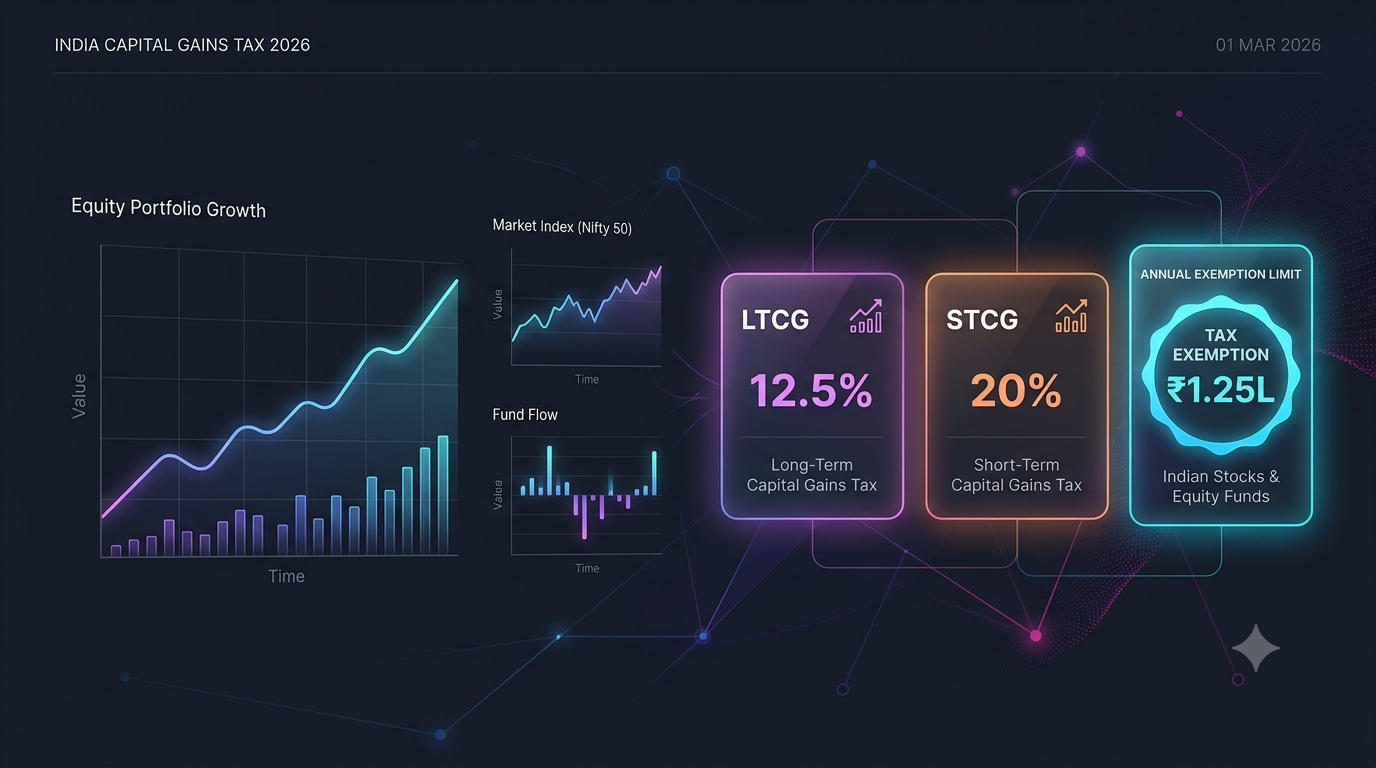
The standard tax rate for STCG on listed equity shares and equity mutual funds (where Securities Transaction Tax or STT is paid) stands at 20% (plus applicable surcharge and 4% health & education cess).
- Calculation Example: Suppose you bought 100 shares of a company for ₹1,000 each (Total: ₹1,00,000) in January and sold them in August for ₹1,50,000. Your net short-term gain is ₹50,000. Under the STCG tax rate of 20%, your total tax liability on this trade will be ₹10,000 (excluding cess).
Note: STCG is charged at a flat rate regardless of your personal income tax slab rate. Even if you fall in the 10% or 30% tax slab, your equity STCG stays fixed.
3. Long-Term Capital Gains Tax (LTCG) & Exemption Limits
Holding stocks and equity mutual funds for the long haul (more than 12 months) comes with tax benefits, but profits above a specific threshold are still taxable.
LTCG Tax Rate & ₹1.25 Lakh Exemption
Long-Term Capital Gains (LTCG) on listed equities and equity funds are taxed at a flat rate of 12.5% (without indexation benefits). However, the tax department provides a annual exemption limit:
The first ₹1,25,000 (₹1.25 Lakh) of total LTCG made in a single financial year is completely TAX-FREE. You only pay 12.5% tax on gains that exceed this ₹1.25 Lakh threshold.
| Tax Parameter | Short-Term (STCG) | Long-Term (LTCG) |
|---|---|---|
| Holding Period | 12 months or less | More than 12 months |
| Tax Rate | 20% | 12.5% |
| Annual Tax-Free Limit | Nil (Fully Taxable) | ₹1,25,000 per financial year |
| Indexation Benefit | No | No |
- Real-World LTCG Example: If you accumulated ₹2,00,000 in long-term capital gains this year by selling long-held blue-chip stocks, your tax calculation will look like this:
• Total Gains: ₹2,00,000
• Less Tax-Free Exemption: ₹1,25,000
• Taxable Gains: ₹75,000
• Tax Payable (12.5% of ₹75,000): ₹9,375 (plus cess).
4. Mutual Fund Taxation Breakdown
According to guidelines from the Association of Mutual Funds in India (AMFI), mutual funds are taxed based on their asset allocation structure:
Equity-Oriented Mutual Funds
Funds that invest 65% or more of their total assets in Indian equities (such as Large Cap, Mid Cap, Small Cap, and Flexi Cap funds) follow standard equity tax rules: 20% for STCG (under 1 year) and 12.5% for LTCG above ₹1.25 Lakhs (over 1 year).
Debt & Conservative Hybrid Mutual Funds
Funds holding less than 35% equity exposure (like pure Liquid Funds, Corporate Bond Funds, and Target Maturity Funds) bought after April 1, 2023, do not enjoy long-term capital gain tax concessions. All gains from these funds—regardless of how long you hold them—are added directly to your taxable income and taxed according to your individual **Income Tax Slab Rate**.
5. Dividend Income Taxation: How Taxes Are Deducted (TDS)
Dividend income earned from listed stocks or mutual fund IDCW (Income Distribution cum Capital Withdrawal) options is completely taxable in the hands of the investor.
- Tax Slab Treatment: Dividend payouts are added to your total annual income and taxed according to your applicable slab rate (e.g., 5%, 10%, 20%, or 30%).
- Tax Deducted at Source (TDS): If your total dividend payout from a single company or mutual fund house exceeds **₹5,000 in a financial year**, the company is legally required to deduct 10% TDS before releasing the payout. You can claim credit for this TDS when filing your Income Tax Return (ITR).
6. Smart Tax-Loss Harvesting Strategy for 2026
Tax-Loss Harvesting is a completely legal method to minimize your capital gains tax liability before the financial year ends on March 31st.
How Tax-Loss Harvesting Works:
- Offsetting Gains with Losses: You can set off realized capital losses against realized capital gains to reduce your net taxable income.
• Short-term capital losses (STCL) can be set off against both STCG and LTCG.
• Long-term capital losses (LTCL) can only be set off against LTCG. - The “Harvest & Rebuy” Method: If you have booked ₹1,80,000 in long-term gains this year, you face tax on ₹55,000 (since ₹1.25L is exempt). If your portfolio contains underperforming stocks currently sitting at a unrealized loss of ₹55,000, you can sell those losing positions to realize the loss, bringing your net gain back down to ₹1.25 Lakh (₹0 tax payable). You can then reinvest the proceeds into promising opportunities.
Frequently Asked Questions (FAQs)
What is the LTCG tax rate for stocks in 2026?
Long-Term Capital Gains (LTCG) on listed equity stocks and equity mutual funds held for over 12 months are taxed at 12.5% for gains exceeding the annual ₹1.25 Lakh tax-free limit.
Is SIP return taxable every year?
No. SIP returns are not taxed while your money remains invested. Tax is only triggered when you redeem or sell your mutual fund units. Note that each individual SIP installment is treated as an independent investment with its own 12-month holding clock for LTCG classification.
Can I carry forward capital losses to future years?
Yes. If your capital losses exceed your capital gains in a financial year, you can carry forward the unadjusted losses for up to 8 consecutive assessment years, provided you file your ITR before the due date.
Key Takeaway for Investors:
Never let taxes be the sole driver of your investment decisions, but always structure your portfolio to maximize tax efficiency. Utilizing your annual ₹1.25 Lakh LTCG exemption and executing annual tax-loss harvesting can save you tens of thousands of rupees over your wealth-building journey.
Financial Disclaimer: The information provided in this article is for educational and informational purposes only and does not constitute financial advice. SME investments carry high structural and liquidity risks. Always consult with a SEBI-registered investment advisor before deploying capital into the markets.