

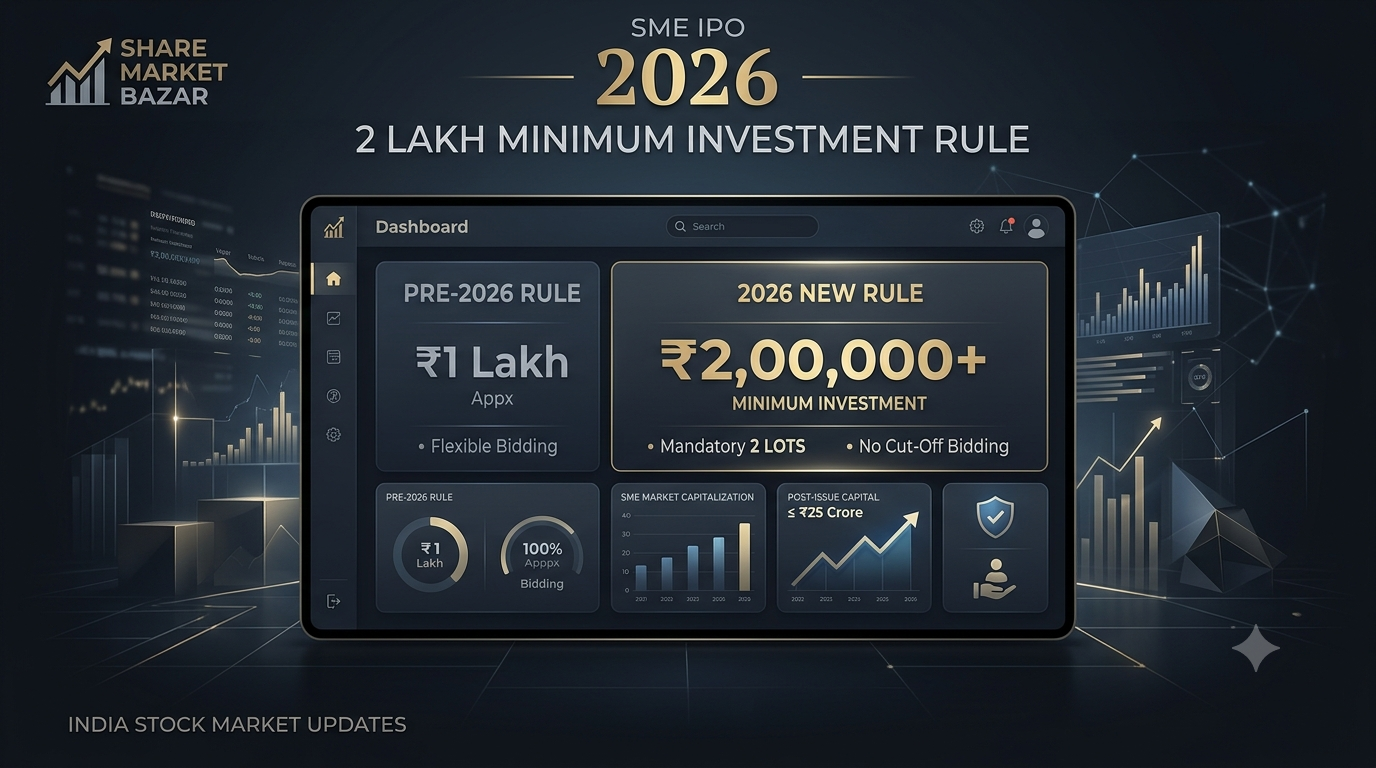
The New SME IPO 2 Lakh Rule: What Retail Investors Need to Know in 2026
If you have been tracking the explosive growth of the SME market, you have likely noticed a major shift in how initial public offerings are being structured. Gone are the days when you could test the waters of a small and medium enterprise with a standard ₹15,000 retail application. The regulatory landscape has changed dramatically. Let us understand the new SME IPO 2 Lakh minimum investment rule
Under the latest SEBI guidelines, the minimum entry barrier for SME IPOs has been significantly raised. Understanding the SME IPO 2 Lakh minimum investment rule is no longer just about knowing the math—it is about deciding whether this high-risk, high-reward segment still fits your portfolio.
Understanding SEBI’s 2 Lakh Minimum Investment Rule
The Securities and Exchange Board of India (SEBI), in coordination with NSE and BSE, has fundamentally restructured how individual investors participate in the SME segment. Effective across current market operations, the minimum application size for an SME IPO has been increased from ₹1 lakh to ₹2 lakh.
In practical terms, this means that an individual investor must now apply for a mandatory minimum of 2 lots when investing in an SME IPO, automatically pushing the application size above the ₹2 lakh threshold. The old “Retail Individual Investor” category has essentially been replaced by this new “Individual Investor” framework for SMEs.
Why Did SEBI Double the Minimum Application Size?
The regulator’s goal is straightforward: investor protection. SME IPOs are meant for early-stage, growing companies whose post-issue paid-up capital does not exceed ₹25 crore. Because these companies are smaller, their stocks often face lower liquidity and higher volatility post-listing.
By raising the barrier to ₹2 lakh, SEBI actively restricts speculative retail participation. The regulator wants to ensure that only investors who can absorb early-stage liquidity risks—and who conduct deep fundamental due diligence—are participating in this space.
SME IPO vs. Mainboard IPO: The Minimum Investment Shift
To put this into perspective, here is how the bidding mechanics now compare across the two major listing platforms. (Note: If you are new to public offerings, check out our complete Mainboard IPO Guide for the basics).
| Parameter | Mainboard IPO | SME IPO (NSE Emerge / BSE SME) |
|---|---|---|
| Minimum Investment | ~₹14,000 to ₹15,000 (1 Lot) | Above ₹2 Lakhs (Minimum 2 Lots) |
| Cut-off Price Bidding | Allowed for Retail Investors | Not Allowed (Must specify exact bid) |
| Bid Modification/Cancellation | Allowed within market hours | Not Allowed for any category |
| Company Size Ceiling | No upper cap | Post-issue capital ≤ ₹25 Crore |
How This Impacts Your Bidding Strategy
If you are planning to apply for an upcoming SME issue, you need to adjust your approach immediately. First, remember that cut-off price bidding is no longer permitted for any investor category in SME IPOs. You must explicitly bid at a specific price within the given band.
Second, no modification or cancellation of bids is allowed once placed. Furthermore, the bidding window for all categories now strictly closes at 4:00 PM on the final day, though you have until 5:00 PM to confirm your UPI mandate.
Finally, blocking over ₹2 lakh for a single SME company concentrates your risk significantly. Ensure the company meets the new stringent profitability requirements—specifically, an operating profit (EBITDA) in at least 2 of the 3 preceding financial years. For a deep dive into analyzing these companies, read our technical analysis strategies.
Is the SME Market Still Worth It?
Absolutely, but it is no longer a lottery ticket for small retail traders. The SME segment requires deep research into the promoter’s track record, a thorough read of the mandatory prospectus, and a long-term holding mindset.
Frequently Asked Questions (FAQs)
Can I apply for just 1 lot in an SME IPO?
No. Under the updated SEBI rules, the mandatory minimum application for individual investors is now 2 lots, which pushes the total investment size strictly above the ₹2 lakh mark.
Is cut-off bidding allowed for SME IPOs?
No. Placing bids at the cut-off price is no longer applicable or available to any category of bidding in an SME IPO. You must place a bid at a specific price.
Do the new rules apply to both NSE Emerge and BSE SME?
Yes. The overarching SEBI regulations regarding the ₹2 lakh minimum application sizes and bidding restrictions apply uniformly across the SME platforms of both major exchanges.
Financial Disclaimer: The information provided in this article is for educational and informational purposes only and does not constitute financial advice. SME investments carry high structural and liquidity risks. Always consult with a SEBI-registered investment advisor before deploying capital into the markets.


