

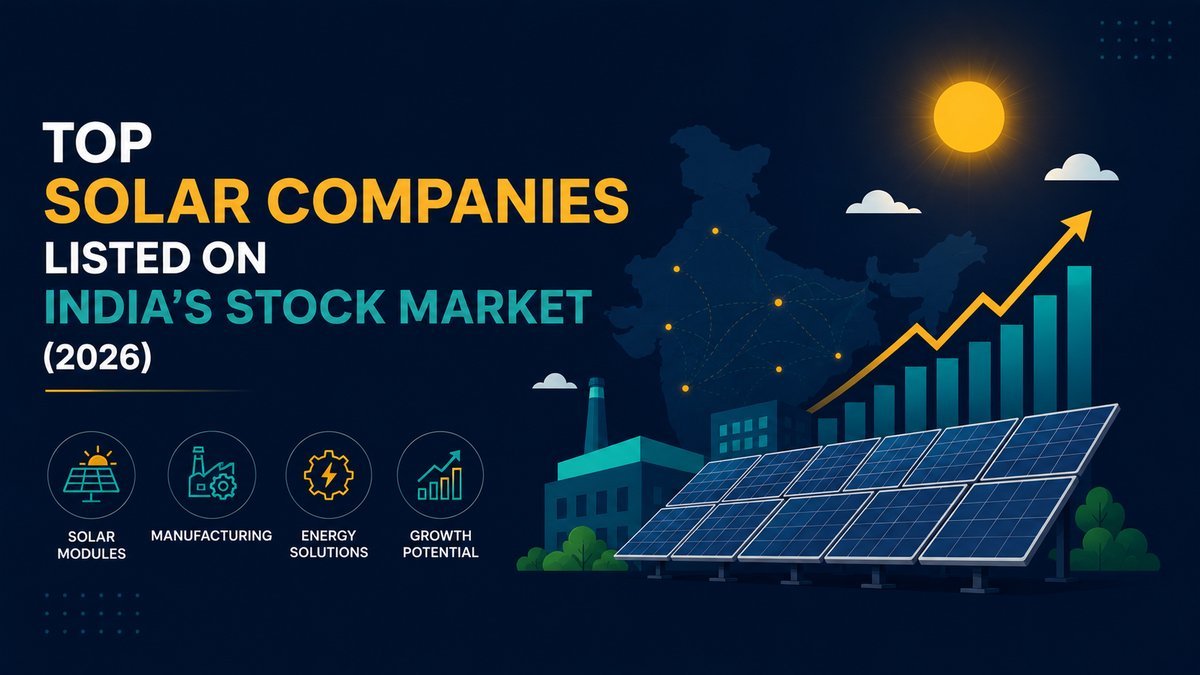
“Solar stock” gets used as if it means one thing, but the companies people lump under that label do genuinely different jobs — some manufacture the panels, some run the power plants, some just build projects for whoever’s paying. Understanding which is which matters more than any single company name, so that’s how this is organized. Lets get deep into the top solar companies india stock market.
Why Solar Became a Real Investment Theme in India
India crossed 154 GW of installed solar capacity by May 2026, on a stated path toward 500 GW of total non-fossil fuel capacity by 2030. That growth isn’t happening on its own — it’s being pushed hard by specific government policy: the Production Linked Incentive (PLI) scheme for high-efficiency solar modules, the PM Surya Ghar rooftop solar scheme, and import-content rules under the Approved List of Models and Manufacturers (ALMM) that favor domestic manufacturers. The Union Budget 2026-27 added to that with customs duty exemptions on key inputs like solar glass, aimed squarely at making Indian-made panels cheaper to produce.
That policy backdrop is why so many of the companies below either recently listed or recently started growing fast — the incentives are relatively new, and the market is still working out who benefits most. Much of the push specifically targets manufacturing rather than just generation, because India has historically imported the majority of its solar cells and modules from China. Reducing that dependence, not just adding more solar capacity, is the explicit policy goal behind schemes like PLI and ALMM — and it shows up in places you wouldn’t expect, right down to the glass the panels are made of.
The Manufacturers: Companies That Make the Panels
Waaree Energies is India’s largest solar module manufacturer by capacity, and one of the biggest beneficiaries of the PLI push toward domestic manufacturing — its order book has run into the tens of thousands of crores. Premier Energies is a similarly positioned manufacturer that listed around the same time, in November 2024, making both companies still relatively new to public markets with limited multi-year track records to judge yet. Websol Energy operates at a smaller scale in the same manufacturing space, which comes with more upside sensitivity but also more risk if demand or policy shifts.
The Supply Chain: Companies That Make What Goes Into a Panel
A solar panel isn’t just cells and a frame — it needs a specific kind of glass on top, and Borosil Renewables is currently the only Indian manufacturer of that low-iron solar glass at scale. It’s a genuinely different business from Waaree or Premier: instead of competing on panel assembly, it sits one step further back in the supply chain, selling the input other manufacturers need. That position got a direct boost recently when the government imposed new duties on imported solar glass from countries like Malaysia and China, specifically to protect domestic glass producers — a reminder that policy support in this sector isn’t limited to the companies making headlines.
The Generators: Companies That Run the Power Plants
Adani Green Energy is India’s largest pure-play renewable energy generator, developing what’s intended to be one of the world’s largest renewable energy parks at Khavda in Gujarat, targeting 50 GW of capacity there alone. Worth knowing before researching further: the stock came under significant pressure after a 2023 Hindenburg Research report alleging financial irregularities across Adani Group companies, and has spent the time since attempting to rebuild investor confidence — the kind of company-specific reputational risk that a pure sector story doesn’t capture. NTPC Green Energy, a subsidiary of state-owned power giant NTPC, also listed in November 2024 and represents a very different risk profile — government-backed rather than founder-driven, with the balance sheet backing of its much larger parent company behind it.
The EPC Players: Companies That Build Everyone Else’s Projects
Sterling and Wilson Renewable Energy works as an engineering, procurement, and construction (EPC) contractor, building solar installations for other companies rather than owning and operating power plants itself. Waaree Renewable Technologies plays a similar EPC and project-development role — and it’s worth being careful here, since it’s a completely separate listed company from Waaree Energies (the manufacturer above), despite the shared name and group lineage. Mixing the two up is an easy, common mistake.
KPI Green Energy blurs the line between this category and the generators above: it builds solar and solar-wind hybrid projects for clients under one business line, while also developing and holding onto some projects to operate and earn revenue from directly. It recently signed a large contract with government-owned SJVN for a project at the same Khavda site where Adani Green is building its flagship park — a useful reminder that big renewable sites often host multiple unrelated listed companies working on different pieces of the same location.
The Diversified Players: Solar as Part of a Bigger Business
Tata Power isn’t a pure renewable-energy company — it runs thermal, hydro, and distribution businesses alongside an aggressively expanding solar arm covering rooftops, utility-scale projects, and EV charging infrastructure. JSW Energy follows a similar pattern, with a growing solar pipeline sitting inside a broader, diversified power generation business. Both give you solar exposure blended with other, less policy-dependent revenue, which cuts both ways: less concentrated upside if solar has an exceptional decade, but less concentrated downside if it doesn’t. Neither approach — pure-play or diversified — is objectively correct; they answer different questions about how much sector-specific risk someone actually wants.
A sector having a good decade doesn’t mean every company in it has one. The policy tailwind is real; which specific businesses actually convert it into profit is a separate, much harder question.
How Much Solar Exposure Actually Makes Sense?
Owning three or four different solar companies feels diversified compared to owning just one, but it isn’t diversified against the risk that actually threatens this sector most: policy change. If a future government scaled back PLI incentives or import protections, that wouldn’t hit one company and spare the rest — it would pressure the entire sector at once, manufacturers and generators alike. Spreading money across Waaree, Adani Green, and Tata Power still leaves all three positions exposed to the same underlying policy risk, just wearing different names.
That’s not a reason to avoid the sector — it’s a reason to think of solar as one theme sitting inside a broader, more genuinely diversified portfolio, rather than a self-contained diversification strategy on its own.
What This Isn’t: A Buy List
None of the above is a recommendation to buy any of these companies. Several listed within the last two years and don’t have the multi-year track record that usually matters for judging management execution, and even the more established names carry sector-specific risks — policy changes, input cost swings, execution delays on large projects — that a one-paragraph description can’t capture. Company-specific issues compound this further: reputational events, leadership changes, or a single missed project deadline can move any one of these stocks independently of how the broader solar theme is doing.
Before looking at any specific company, our framework for evaluating a stock before buying is a more useful starting point than a company name pulled from an article. If terms like P/E ratio or market cap above weren’t fully clear, our full glossary covers those and more.
For official data on India’s renewable energy capacity and policy, the Ministry of New and Renewable Energy’s site publishes figures directly from the source rather than through a market commentary layer.
Frequently Asked Questions
Are solar stocks safer than other stocks because the sector is growing?
No — sector growth and individual company risk are different things. A growing sector can still have specific companies that struggle with debt, execution, or competition, so sector tailwinds don’t substitute for evaluating the actual business behind any single stock.
What’s the difference between a solar manufacturer and a solar generator stock?
A manufacturer sells physical equipment like panels and cells, so its revenue depends on production volume and demand for hardware. A generator owns and operates power plants, earning revenue from electricity sold over the long term — closer to a utility business than an industrial one.
Do government incentives guarantee these companies stay profitable?
No. Incentive schemes can change, get extended, or get reduced with future policy decisions, and companies that depend heavily on a specific scheme carry the risk of that scheme shifting under them. That’s a genuine, ongoing risk for this entire sector, not a one-time concern that gets resolved once a scheme is announced.
Why aren’t smaller or newer solar companies on this list?
Several smaller, lower-priced solar-adjacent stocks exist beyond the names here, but many are too newly listed or too thinly researched to describe responsibly in a short overview. This list favors companies with enough public track record and information available to say something genuinely useful, rather than being exhaustive — a longer list padded with names we can’t confidently describe wouldn’t actually serve you better.
Financial Disclaimer: The information provided in this article is for educational and informational purposes only and does not constitute financial advice. SME investments carry high structural and liquidity risks. Always consult with a SEBI-registered investment advisor before deploying capital into the markets.

