

A demat account sounds like it should be complicated — regulators, depositories, paperwork with three-letter acronyms. In practice, the process itself takes about fifteen minutes online. What actually matters is knowing what you’re signing up for before you start, including a couple of rules that changed recently and that most guides haven’t caught up with yet.
What You Actually Need Before You Start
Four things, no more: your PAN card, an address proof (Aadhaar, passport, or a recent utility bill), a bank account in your own name to link for payouts, and a recent photograph. Nearly every broker now accepts all of this digitally — you’re rarely mailing physical copies anywhere, and most applications are approved within a day.
The Step-by-Step Process
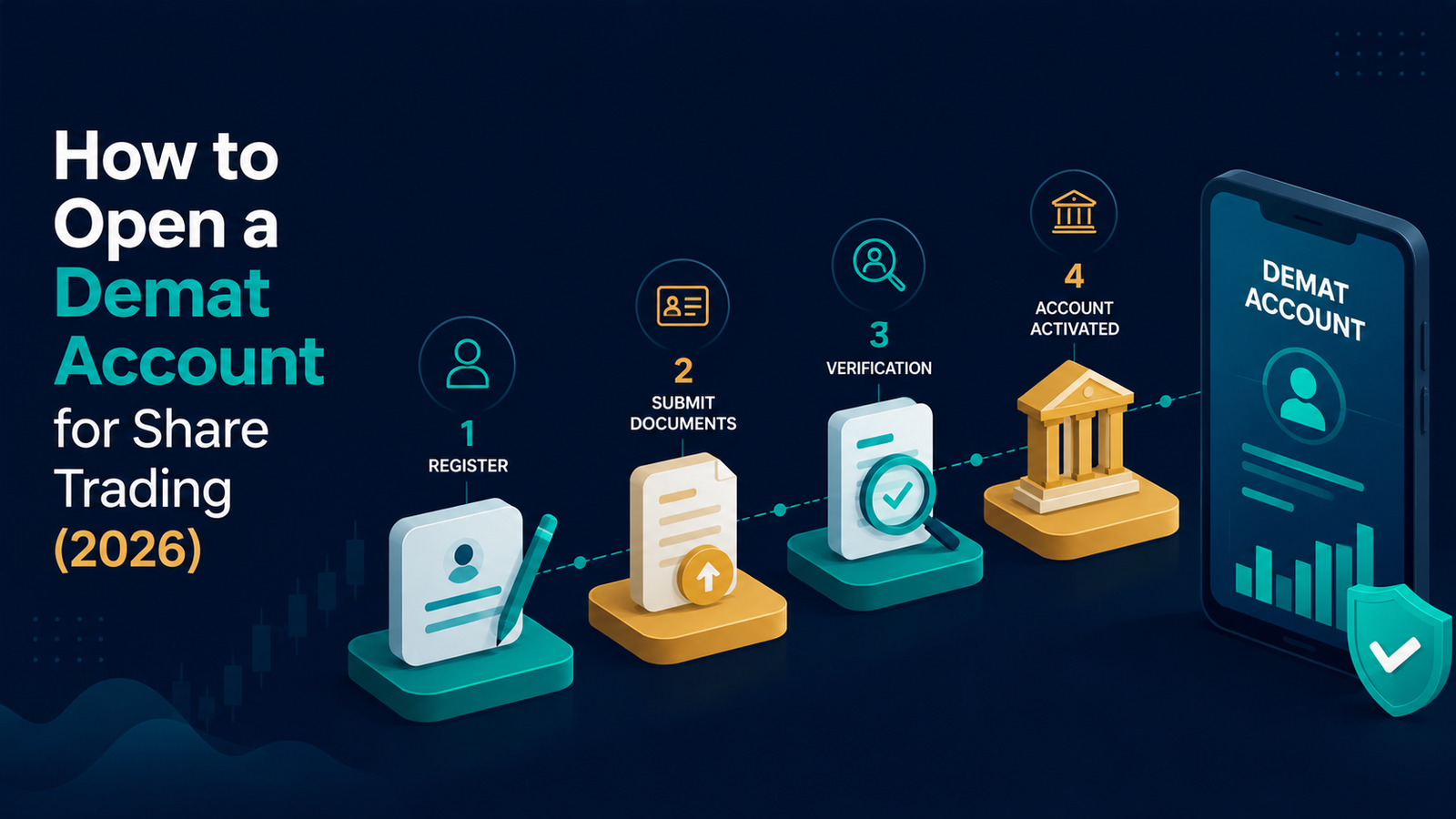
Step 1: Pick Your Depository Participant
You don’t open a demat account directly with a depository — you open it through a Depository Participant (DP), which is almost always the same broker or app you’ll use for trading. Our roundup of stock market apps is a reasonable place to start if you haven’t picked one yet, since your DP and your trading app are usually the same decision.
Step 2: Complete KYC and In-Person Verification
Beyond the basic documents, SEBI requires In-Person Verification (IPV) for every new account — but “in person” now usually means a short video call rather than an actual office visit. Have your PAN and a plain background ready; most brokers complete this in under five minutes.
Step 3: Nominate a Beneficiary (Not Optional Anymore)
This is the step most beginners skip, and it’s no longer something you can quietly ignore. SEBI now requires every investor to either formally nominate a beneficiary or explicitly opt out in writing — you can name up to ten nominees and specify what percentage of your holdings each one receives. If something happens to you, a nominated demat account transfers to your family in a fraction of the time an un-nominated one takes through succession paperwork. It takes two minutes to fill in. Do it during account opening, not “sometime later.”
Step 4: Link Your Bank Account
This is where money actually moves in and out — dividends, sale proceeds, and funds for new purchases all route through this linked account. Double-check the account number and IFSC code before confirming; a mismatched bank link is the single most common reason new investors get stuck waiting on their first payout.
Power of Attorney vs. e-DIS: How You Authorize a Sale
When you sell shares, someone needs authorization to move them out of your demat account, and there are two ways to grant it. A Power of Attorney (POA) gives your broker standing authorization to debit shares without asking each time — convenient, but it’s also handed brokers more control than some investors are comfortable with, which is exactly why regulators pushed brokers toward alternatives. Most brokers today default to e-DIS or a TPIN-based system instead, where you approve each sale individually through an OTP or PIN at the time of the transaction. It’s one extra step per sale, but you’re not handing over blanket authorization to move your holdings. Unless you have a specific reason to want a POA, there’s little upside to signing one anymore.
Regular Demat Account vs. BSDA — Which Do You Actually Get?
Most first-time investors are automatically opened into a Basic Services Demat Account (BSDA) rather than a regular one, and that’s a genuine cost saving, not a downgrade. As of SEBI’s most recent rules, you qualify for BSDA if it’s your only demat account, held in your name as sole or first holder, with total holdings under ₹10 lakh. Since late 2025, eligible accounts default into BSDA status automatically — you’d have to actively request a regular account in writing if you wanted one instead, which most beginners simply don’t need to.
If your portfolio eventually crosses ₹10 lakh, your account converts to a regular demat account automatically at the next review, and standard charges apply from there.
What It Actually Costs
- Account opening: Free at most discount brokers; some full-service brokers still charge a nominal one-time fee.
- BSDA annual maintenance: Typically nothing up to ₹4 lakh in holdings, and roughly ₹100 a year between ₹4 lakh and ₹10 lakh.
- Regular account AMC: Varies by broker, generally a few hundred rupees a year once your holdings cross the BSDA threshold.
- DP charges on selling: A small per-transaction charge every time you sell shares out of the account, separate from any brokerage.
The account itself doesn’t make you money or lose you money. It’s just the locker. What you put in it is the part that actually matters.
If you’re still deciding whether you’re ready to open one at all, our beginner’s guide is worth reading first — this piece assumes you’ve already made that decision and just want the mechanics done right.
For the current, official rules on BSDA eligibility and nomination requirements straight from the source, CDSL’s own site publishes investor circulars as they’re issued, ahead of most blogs covering them.
Frequently Asked Questions
Can I have more than one demat account?
Yes, across different brokers if you want, but only one of them can ever qualify as a BSDA — the rest would be regular accounts with standard charges, regardless of how small the holdings in each one are.
Is opening a demat account free?
Account opening itself is free at most discount brokers. What you’ll actually pay for, if anything, is the annual maintenance charge once your holdings pass the BSDA threshold, plus small per-transaction charges when you sell — none of which show up until after the account is already open.
What happens to my demat account if I stop trading for a long time?
Nothing happens to your holdings — they stay exactly as they are, and there’s no rule that closes an account for inactivity alone. You’ll still be charged whatever annual maintenance applies to your account type, so an inactive account with meaningful holdings isn’t free just because you’re not trading.
The Bottom Line:
If you are tired of waiting for UPI mandates to arrive on your phone or chasing customer support for delayed IPO refunds, it is time to switch to traditional Net Banking ASBA. It is secure, incredibly reliable, and keeps your hard-earned money strictly under your control.
Financial Disclaimer: The information provided in this article is for educational and informational purposes only and does not constitute financial advice. SME investments carry high structural and liquidity risks. Always consult with a SEBI-registered investment advisor before deploying capital into the markets.