If you are planning to enter the Indian stock market, your very first step is choosing the right stockbroker. However, with heavy marketing campaigns and overlapping features, finding the best platform has never been more confusing. Are “zero brokerage” claims entirely true, or are there hidden fees lurking in the fine print? Let’s check Zerodha vs Groww vs Angel One Charges 2026 and Which Demat is Best?
In this comprehensive guide, we are doing a deep dive into the Zerodha vs Groww vs Angel One charges 2026 debate. These three discount broking giants dominate the Indian retail investing space, but their underlying fee structures are entirely different. By the end of this article, you will know exactly which Demat and Trading account suits your personal investing style and saves you the most money in taxes and fees.
1. Account Opening and AMC (Annual Maintenance Charges)
The first cost you encounter when starting your stock market journey is the onboarding fee. While most brokers have eliminated account opening charges to attract users, they make up for it through AMC (Annual Maintenance Charges).
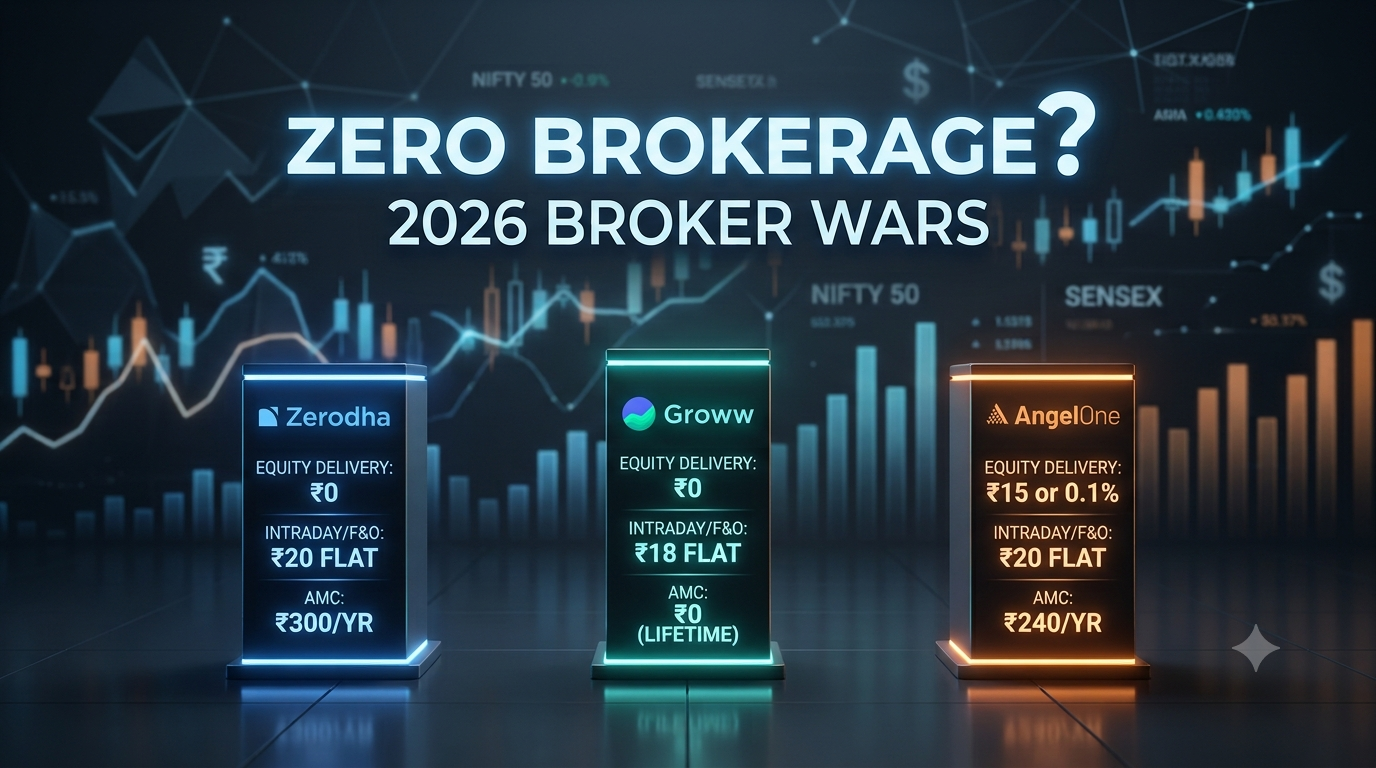
| Broker | Account Opening Fee | Annual Maintenance Charge (AMC) |
|---|---|---|
| Zerodha | ₹200 (For Equity & F&O) | ₹300 per year (Charged quarterly) |
| Groww | Free (₹0) | Free (₹0 Lifetime AMC) |
| Angel One | Free (₹0) | ₹240 per year (Free for the 1st year) |
Winner for Beginners: Groww takes the lead here. If you are a student or a beginner who just wants to invest in mutual funds and buy a few stocks occasionally, Groww’s lifetime zero AMC policy makes it the most cost-effective starting point.
2. Core Brokerage Charges (Delivery, Intraday, F&O)
Brokerage is the primary fee your broker charges for executing your buy and sell orders. In 2026, the standard discount broking model dictates a “flat fee” structure, but there is a massive difference when it comes to long-term equity investing (Delivery).
| Trading Segment | Zerodha Charges | Groww Charges | Angel One Charges |
|---|---|---|---|
| Equity Delivery (Long Term) | ₹0 (Completely Free) | ₹20 or 0.1% (whichever is lower) | ₹20 or 0.1% (whichever is lower) |
| Equity Intraday (Day Trading) | ₹20 or 0.03% (whichever is lower) | ₹20 or 0.1% (whichever is lower) | ₹20 or 0.1% (whichever is lower) |
| Futures & Options (F&O) | ₹20 per executed order | ₹20 per executed order | ₹20 per executed order |
The Delivery Trap: Both Groww and Angel One charge ₹20 per order even if you are just buying shares to hold in your Demat account for years. On the other hand, Zerodha maintains its legacy promise: Equity Delivery is absolutely free. If you are building a long-term portfolio through systematic stock SIPs, Zerodha will save you thousands of rupees in brokerage over the years.
3. DP Charges (The Hidden Selling Cost)
Most beginners ignore DP (Depository Participant) charges because they are rarely advertised. A DP charge is a flat fee levied by the central depository (CDSL/NSDL) and the broker every time you sell a stock from your Demat holding. It does not apply to intraday trades or F&O.
- Zerodha DP Charges: ₹13.50 + 18% GST (Approx. ₹15.93 per stock sold per day)
- Groww DP Charges: ₹20.00 + 18% GST (Approx. ₹23.60 per stock sold per day)
- Angel One DP Charges: ₹20.00 + 18% GST (Approx. ₹23.60 per stock sold per day)
Once again, Zerodha boasts the lowest DP charges among the top three. If you are booking profits across a portfolio of 15 different stocks, Groww and Angel One will charge you significantly more in backend depository fees.
4. Platform Features, UI, and Target Audience
Beyond the raw Zerodha vs Groww vs Angel One charges 2026 comparison, your daily experience depends entirely on the mobile app’s user interface and stability.
Zerodha (Kite App)
Zerodha is the undisputed king of clean, minimalist, and professional trading interfaces. The Kite platform is incredibly fast and offers advanced charting tools powered by TradingView. There is no stock advisory or “tips” section, which prevents beginners from getting distracted. It is built strictly for serious investors and active F&O traders.
Groww
Groww is built for the modern Gen-Z investor. Its UI is exceptionally colourful, simple, and decluttered. It integrates direct mutual fund investments, sovereign gold bonds, and US stocks seamlessly. However, hardcore options traders often find Groww lacking in advanced technical indicators and heavy order-execution speed during extreme market volatility.
Angel One (Super App)
Angel One operates on a hybrid model. Unlike Zerodha and Groww, Angel One provides full-service advisory. Their app pushes stock recommendations, ARQ Prime AI-based picks, and portfolio health metrics. If you are someone who wants “stock tips” bundled with your discount broking account, Angel One provides tremendous value.
Final Verdict: Which Broker Should You Choose in 2026?
There is no “one size fits all” broker. Based on our detailed charges and feature comparison, here is the final verdict:
- Choose Zerodha IF: You are a long-term equity investor (Free Delivery is unbeatable), you want the lowest DP charges, and you demand a stable, professional charting platform for active F&O trading.
- Choose Groww IF: You are an absolute beginner looking for a zero-maintenance (No AMC) account, and your primary focus is Mutual Fund SIPs rather than aggressive daily stock trading.
- Choose Angel One IF: You want a discount broker that also provides built-in stock recommendations, research reports, and higher margin funding facilities for positional trades.
Frequently Asked Questions (FAQs)
Does Zerodha still offer free equity delivery in 2026?
Yes, Zerodha remains one of the only top discount brokers in India that charges ₹0 brokerage for long-term equity delivery trades.
Are there any hidden charges in Groww?
Groww has no hidden account maintenance charges, but they do charge ₹20 (or 0.1%) for equity delivery buys and sells, along with a flat ₹20 + GST as DP charges every time you sell stock from your portfolio.
Which broker is best for Options Trading?
Zerodha is generally preferred by active F&O traders due to the stability of the Kite platform during volatile expiry days, advanced order types (GTT, Iceberg), and integration with tools like Sensibull.
Pro Tip for Traders:
Always calculate your break-even points before placing a trade. Brokerage is just one part of the puzzle—STT, Exchange Transaction Charges, SEBI fees, and GST often add up to more than the actual brokerage fee itself!
Financial Disclaimer: The information provided in this article is for educational and informational purposes only and does not constitute financial advice. SME investments carry high structural and liquidity risks. Always consult with a SEBI-registered investment advisor before deploying capital into the markets.