
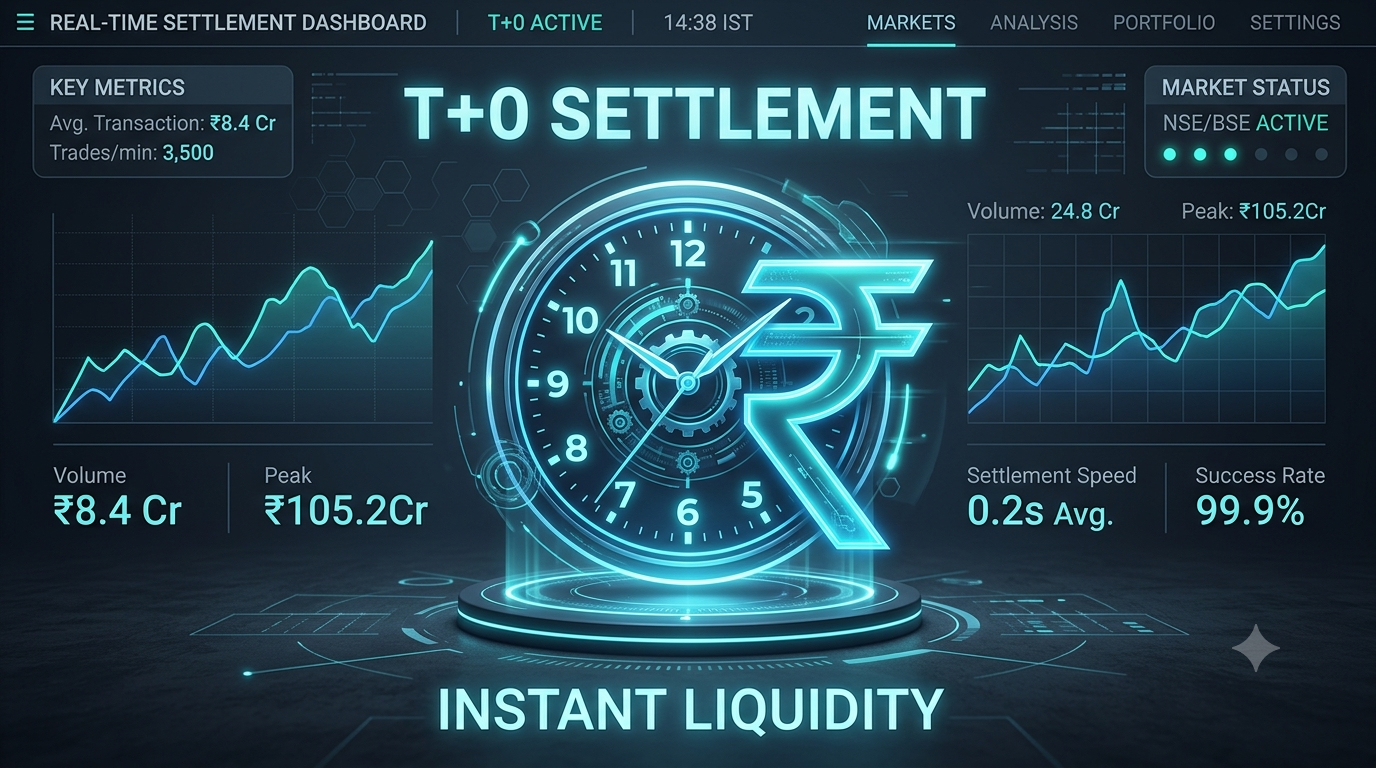
If you sell your shares today, when exactly will the money hit your bank account? For decades, retail investors in India had to endure a frustrating waiting period. However, in 2026, the Indian equity landscape has officially entered the era of instant gratification with the widespread adoption of the T+0 settlement Indian stock market 2026 cycle.
The Securities and Exchange Board of India (SEBI) has continually pushed the boundaries of global finance to protect investors and increase market efficiency. By 2026, T+0 settlement is operational for the top 500 stocks listed on the National Stock Exchange (NSE) and Bombay Stock Exchange (BSE) on an optional basis. This monumental shift has positioned India as a pioneer in global equity market infrastructure, perfectly aligning its financial systems with the real-time expectations set by digital innovations like Unified Payments Interface (UPI).
In this comprehensive guide, we will break down exactly how the T+0 settlement works, the strict cut-off timings you must follow, and how this real-time liquidity impacts your daily trading strategies.
1. What Exactly is the T+0 Settlement Cycle?
To understand the magnitude of this change, we must first look at how the market traditionally operated. In stock market terminology, the letter ‘T’ refers to the trade date (the day you execute your buy or sell order). The number following the ‘+’ indicates the number of business days after the trade date when the actual settlement (transfer of funds and securities) is completed.
- The T+2 Era: Historically, under the T+2 system, a trade executed on a Monday would not settle until Wednesday. Your funds were locked in transit.
- The T+1 Era: In a major upgrade, SEBI implemented the T+1 Settlement Cycle on January 27, 2023. Under this system, settlement was completed the next trading day.
- The T+0 Era (2026): T+0 settlement means that the process is completed on the same day the trade is executed, making it the fastest settlement cycle available. There is no overnight wait.
2. How T+0 Works in 2026: Rules & Cut-off Timings
Because the stock exchanges must process billions of transactions, same-day settlement requires strict operational windows. It is important to note that T+0 trades happen in a separate window from regular T+1 trades.
If you wish to participate in the optional T+0 settlement, you must adhere to the following timeline:
- The Trade Window: You must place your trade before 1:30 PM in the specific T+0 settlement window on the exchange. Trades made until 1:30 PM will be considered for settlement on the same day.
- The Settlement Window: Once executed, the settlement happens on the same day by 4:30 PM.
Real-Life Example: Imagine selling your gold jewelry at 11 AM and getting the money by 4 PM. Now apply that to your stocks: If you sell shares of a company like Infosys at 11:00 AM in the T+0 window, the funds from the sale will be credited to your account by 4:30 PM on the same day.
3. The Rollout Strategy: Which Stocks are Eligible?
SEBI did not transition the entire market overnight; the rollout was highly calculated to prevent systemic shocks. The timeline progressed as follows:
- March 28, 2024: SEBI introduced the beta version of the T+0 settlement cycle with a pilot phase of just 25 select stocks.
- July 2025: The full rollout plan expanded the eligible list to the Top 100 stocks.
- November 2025 onwards: The system was scaled to encompass the Top 500 stocks.
As of 2026, retail investors can freely utilize this optional framework for the top 500 stocks on the NSE and BSE.
4. The Major Benefits of Same-Day Settlement
Why did regulators push so aggressively for this? The transition provides massive advantages for both the retail investor and the broader institutional ecosystem.
A. Faster Liquidity and Capital Recycling
Quicker access to funds or shares enables timely reinvestments. It allows investors to recycle capital within the same trading day. This means you can sell a stock that is underperforming in the morning, and deploy that exact capital into a new opportunity by the afternoon without waiting for settlement cycles, maximizing portfolio liquidity and agility.
B. Reduced Settlement Risk
The longer the settlement cycle, the greater the counterparty risk (the risk of default by the buyer or seller). The T+0 settlement system eliminates the overnight exposure between trade execution and settlement, significantly reducing counterparty risk. This enhances investor confidence for smoother trading experiences.
C. Empowerment for Retail and Women Investors
For everyday retail participants and women investors managing household finances, this aligns with goal-based investing (such as education, home, or retirement funds). Faster liquidity means better financial flexibility and reduced dependency on delayed proceeds during emergencies.
5. Are There Any Drawbacks or Risks?
While the T+0 settlement Indian stock market 2026 cycle is a technological marvel, it brings certain challenges. The introduction of the T+0 settlement system brings about significant changes to the stock market infrastructure, systems, and processes, which could prove to be very complex and expensive for brokers and clearing houses to maintain.
Furthermore, from a market dynamics perspective, the flip side is that periods of high trading activity could result in creating higher market volatility. Because traders can instantly access and redeploy cash, market swings could become sharper on days with heavy news flow.
Frequently Asked Questions (FAQs)
Is T+0 settlement mandatory for all trades in 2026?
No. In 2026, the T+0 settlement is operational for the top 500 stocks on an optional basis. If you do not choose the T+0 window, your trades will continue to settle under the standard T+1 cycle.
What is the cutoff time for T+0 settlement?
You must place your trade before 1:30 PM to qualify for the same-day settlement window.
Does T+0 apply to the F&O segment?
Currently, the immediate focus of the T+0 cycle is on the equity cash market. Derivatives (F&O) operate under separate margin and settlement guidelines. (Read more on SEBI’s New F&O Margin Rules Here).
The Bottom Line:
The T+0 settlement cycle removes the anxiety of “settlement pending” statuses and puts the power of liquidity back into the hands of the investor. By mastering the 1:30 PM cutoff time, you can navigate the Indian stock market with unprecedented financial agility.
Financial Disclaimer: The information provided in this article is for educational and informational purposes only and does not constitute financial advice. SME investments carry high structural and liquidity risks. Always consult with a SEBI-registered investment advisor before deploying capital into the markets.