

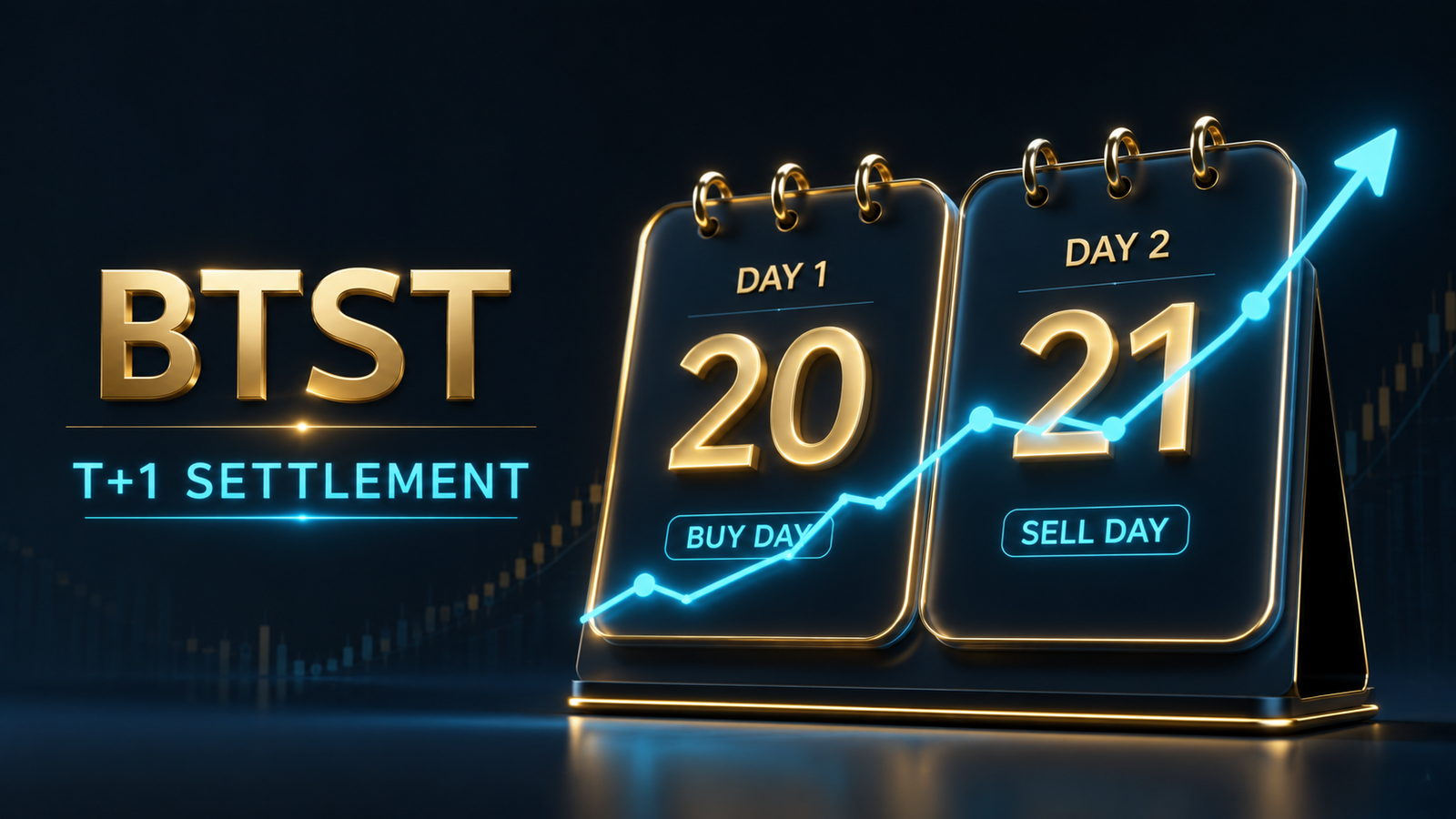
You buy a stock today at 3:15 PM expecting a massive gap-up opening tomorrow morning. The next day, the market opens exactly as you predicted, and you immediately sell the stock to book a quick profit. This highly popular strategy is known as BTST (Buy Today, Sell Tomorrow). But is it completely risk-free? Let’s go through BTST Trading Rules 2026
While the concept sounds incredibly simple, the backend mechanics of BTST have drastically evolved. If you are not completely updated on the latest BTST trading rules 2026, a simple technical glitch in the settlement cycle could wipe out your profits and hit you with a massive exchange penalty.
In this comprehensive guide, we will decode how the new settlement cycles impact your BTST trades, the hidden danger of “Short Delivery,” and the margin requirements you must maintain to trade safely.
1. What Exactly is a BTST Trade?
BTST stands for Buy Today, Sell Tomorrow. In a standard equity delivery trade, when you buy a share, it takes time to digitally arrive in your Demat account. Under normal circumstances, you wait for the shares to be credited before selling them.
However, the BTST facility offered by brokers allows you to sell these shares the very next trading day—even before they have officially hit your Demat account. You are essentially selling shares that are currently “in transit.”
2. How T+0 Settlement Impacts BTST in 2026
The implementation of the T+0 (same-day) settlement cycle by SEBI has fundamentally altered the BTST landscape.
- For T+0 Eligible Stocks: If you trade a stock that falls under the optional T+0 settlement window (executed before 1:30 PM), the shares are credited to your Demat account on the exact same day by 4:30 PM. Therefore, if you sell it the next morning, it is no longer considered a “BTST” trade. It is a standard delivery sell transaction because you already hold the shares in your account.
- For Standard T+1 Stocks: For the thousands of stocks still operating heavily on the standard T+1 cycle, the traditional BTST rules apply. The shares you bought on Monday will arrive on Tuesday evening, but you can sell them on Tuesday morning.
3. The Biggest Hidden Danger: Short Delivery & Auction Penalty
This is the most critical aspect of the BTST trading rules 2026 that beginners ignore. Since you are selling shares on Tuesday that you haven’t actually received yet, what happens if the original seller (who sold them to you on Monday) defaults and fails to deliver the shares?
This scenario is called Short Delivery.
- You bought shares on Monday (expecting them on Tuesday evening).
- You sold those same shares on Tuesday morning to a new buyer.
- On Tuesday evening, the exchange informs you that the Monday seller defaulted. You will not receive the shares.
- Now, you have defaulted on your Tuesday sale because you have no shares to give to the new buyer!
The Penalty: When this happens, the stock exchange conducts an “Auction” to buy the shares at a premium to deliver them to your buyer. You will be hit with an auction penalty, which can range up to 20% of the trade value. This completely wipes out any BTST profit you made.
Pro Tip: Never do BTST in highly volatile penny stocks or stocks hitting lower circuits, as the risk of short delivery is incredibly high.
4. Upfront Margin Requirements for BTST
According to the latest SEBI peak margin rules, you need an upfront margin to execute a sell trade. When you sell a stock via BTST, only 80% of the sale proceeds are credited to your account on that day for further trading. The remaining 20% is blocked as a delivery margin and will be available the next trading day.
If you are looking to take leveraged delivery positions instead of standard BTST, you might want to explore the Margin Trading Facility (MTF) offered by top brokers.
5. Brokerage Charges on BTST Trades
How do brokers charge for BTST? Is it considered an Intraday trade or a Delivery trade?
Even though you are selling the very next day, a BTST trade is treated as a Delivery Trade by all major brokers. This means:
- If you use Zerodha, the brokerage is ₹0 (Free).
- If you use Groww or Angel One, you will pay the standard delivery brokerage of ₹20 or 0.1% (whichever is lower) for both the buy leg and the sell leg.
- You will also have to pay STT (Securities Transaction Tax) and DP charges, just like a regular delivery trade.
Frequently Asked Questions (FAQs)
Can I do BTST on Fridays?
Yes, you can buy on Friday and sell on Monday. The term “Tomorrow” in BTST strictly refers to the next active trading day, ignoring weekends and public holidays.
Do I need a margin to do a BTST trade?
You need 100% of the cash value to buy the stock initially on Day 1. When you sell on Day 2, you don’t need extra cash, but only 80% of your sell amount is unlocked immediately for new trades.
Is BTST allowed for SME IPO stocks?
Generally, BTST is blocked for the Trade-to-Trade (T2T) segment, GSM/ASM category stocks, and newly listed SME IPOs to prevent extreme volatility and manipulation.
The Bottom Line:
BTST is an excellent strategy to capture overnight momentum, gap-ups, and earnings report reactions. However, strictly avoid BTST in illiquid stocks to protect yourself from auction penalties. Always trade with top Nifty 50 or Nifty 500 stocks where liquidity is never an issue.
Financial Disclaimer: The information provided in this article is for educational and informational purposes only and does not constitute financial advice. SME investments carry high structural and liquidity risks. Always consult with a SEBI-registered investment advisor before deploying capital into the markets.


